

SEMI S2's EMO Design Requirements
When EMO is activated, the audible and visual alarm should be immediately triggered and the relevant alarm information should be displayed on the screen. All energy exceeding 240VA must be disconnected. However, the following situations are exceptions:
a) If the energy supply is cut off and other hazards are induced, the energy supply must not be cut off. The safety circuit and non-hazardous voltage EMO circuit (typically 24V) and their power supplies can remain powered on.
b) Components related to safety, such as smoke detectors, gas/water leakage detectors, pressure measurement components, etc., which do not involve hazardous energy, can remain powered on.
c) The computer system that performs functions such as data/alarm input and error response can remain powered. Measures need to be taken to protect against dangerous energy.
d) Clearly marked isolation power circuits or isolated EMO circuits
2. The EMO circuit cannot be bypassed.
3. The EMO design must use N.C. (Normal Close) "normally closed" contacts.
4. The EMO circuit must be of an electromechanical design.
5. The EMO circuit must have a fault-tolerant design;
6. After resetting the EMO button, the circuit, equipment and subsystems cannot be re-powered and restarted.
7. The EMO circuit needs to be shut down by cutting off the power supply.
8. The EMO button is red in color, mushroom-shaped, self-locking, and requires a yellow background.
Here is an example:
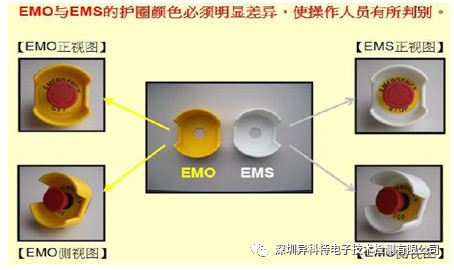
9. EMO indication: It must be marked with "EMO" or "Emergency OFF", and the indication must be clearly visible.
10. Emergency Stop Sign: It must be marked with "EMS" and be clearly visible.
11. The EMO device should have easily accessible positions for installation, operation and maintenance, which can be pressed down with the palm of the hand.
12. The EMO device should be installed in a location that is not easily accessible or prone to accidental touching.
13. The maximum distance between the operation or maintenance position and the EMO button shall not exceed 3 meters (10 feet).
14. EMO should not be installed in high-risk locations.
15. When EMS is triggered, it can halt one or more procedures or actions that are dangerous or hazardous, but it does not completely isolate or control all sources of hazardous energy.
16. The design of EMS should not replace EMO, and the EMS button should be placed next to the EMO for easy distinction.
Related News






 Follow Us
 +86-755-82984733
 sales@ecmg-global.net