

Certification Service | SEMI E33 Semiconductor Manufacturing Equipment Electromagnetic Compatibility (EMC) Guidelines
The necessity of obtaining SEMI E33 certification:
The functional density of semiconductor manufacturing equipment continues to increase, and the electromagnetic environment becomes increasingly complex. Electromagnetic Compatibility (EMC) has become the core challenge in design and selection. Electromagnetic radiation generated by high-speed signals and high-frequency switches not only affects the equipment itself and nearby precision instruments, but also may reduce product yield and increase costs. In response to this phenomenon, the International Semiconductor Industry Association (SEMI) has formulated the SEMI E33 - Semiconductor Manufacturing Equipment Electromagnetic Compatibility (EMC) Guide, which covers a complete compliance system for conductive emissions, radiated emissions, immunity, and extremely low frequency (ELF), controlling electromagnetic interference from the source. Nowadays, leading global wafer fabrication plants have made SEMI E33 compliance a necessary condition for equipment procurement, to ensure stable operation of the production line, improve yield and production continuity.
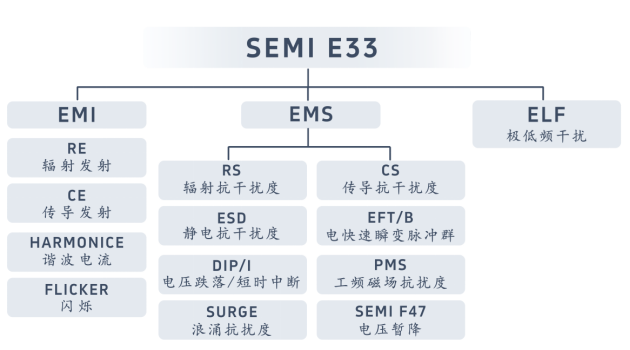
SEMI E33 (Electromagnetic Compatibility) encompasses three core requirements:
1. EMI - Electro Magnetic Interference - Control of Electromagnetic Interference
The electromagnetic interference intensity generated by the equipment or system during its normal operation with respect to the surrounding environment, aiming to prevent environmental pollution and reduce machine operation failures.
2. EMS - Electro Magnetic Susceptibility Electromagnetic Sensitivity
3. ELF - Extremely Low Frequency Interference Control (for devices sensitive to magnetic fields)
The equipment or system can still operate stably in the external electromagnetic interference environment it is in.
In simple terms:
EMI stands for "No Interference to Surrounding Devices" (The electromagnetic interference generated by the device must not exceed a certain limit).
EMS and ELF refer to "not being interfered with by surrounding devices" (the equipment's ability to resist interference needs to meet the standards).
The differences between SEMI E33 and the CE-EMC directive:
CE-EMC: The EMC Directive 2014/30/EU stipulates that all electronic and electrical products are subject to this regulation. Relevant tests are conducted based on common harmonized standards (such as EN 55011, EN 61000 series).
SEMI E33: Focusing on equipment for the semiconductor manufacturing industry, it adds core supplementary technical requirements based on the general EMC basic requirements, specifically addressing the uniqueness of semiconductor manufacturing equipment. It also incorporates extremely low-frequency interference (ELF) and takes into account requirements such as EMI audits and grounding.
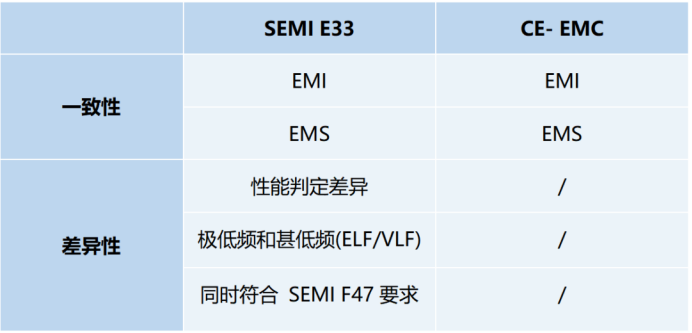
When a product enters the EU market, it must comply with the requirements of the CE-EMC directive. However, when semiconductor manufacturing equipment enters a wafer fabrication plant, to ensure the stability of the equipment, it must further meet the more stringent "SEMI E33" standards.
ECMG is equipped with a complete set of professional-level electromagnetic compatibility (EMC) testing instruments. The core engineers have been deeply involved in the EMC industry for over 20 years and are well-versed in the requirements of SEMI E33 standards. Relying on solid software and hardware technical capabilities, we are always committed to providing precise, efficient, and compliant professional EMC solutions for semiconductor equipment customers, ensuring the stable operation of the equipment and facilitating successful certification.
Related News




 Follow Us
 +86-755-82984733
 sales@ecmg-global.net