

【Recommendation】Basic Knowledge of Wafer Surface Cleaning
Before the silicon wafers enter the CMOS manufacturing process, their surfaces must be cleaned to remove any adhered particles and organic/inorganic impurities, as well as the natural oxide of silicon. The constantly shrinking chip design makes cleaning technology increasingly important for achieving an acceptable product yield. In modern semiconductor device manufacturing, the wafer cleaning process can account for 30% to 40% of the entire manufacturing process steps. Wafer cleaning has a long history in the semiconductor industry. For more detailed discussions, one can refer to the discussions and research by authors such as Werner Kern and Tadahiro Ohmi on the classic methods.
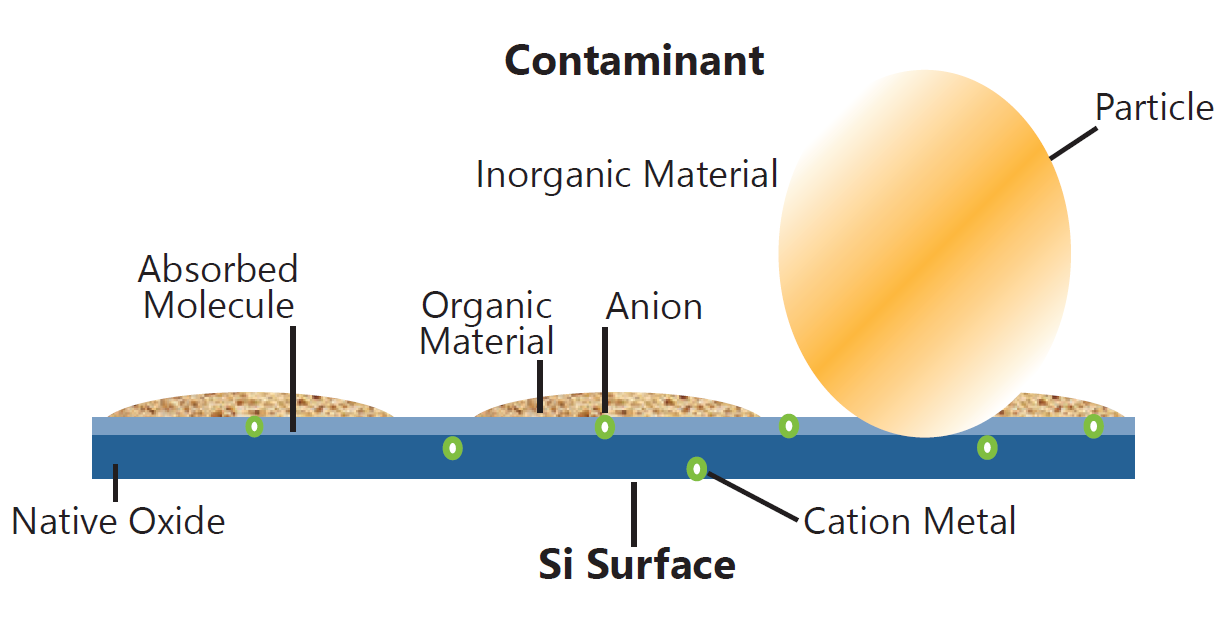
▲ Figure 1. Possible contaminants on the surface of a silicon wafer
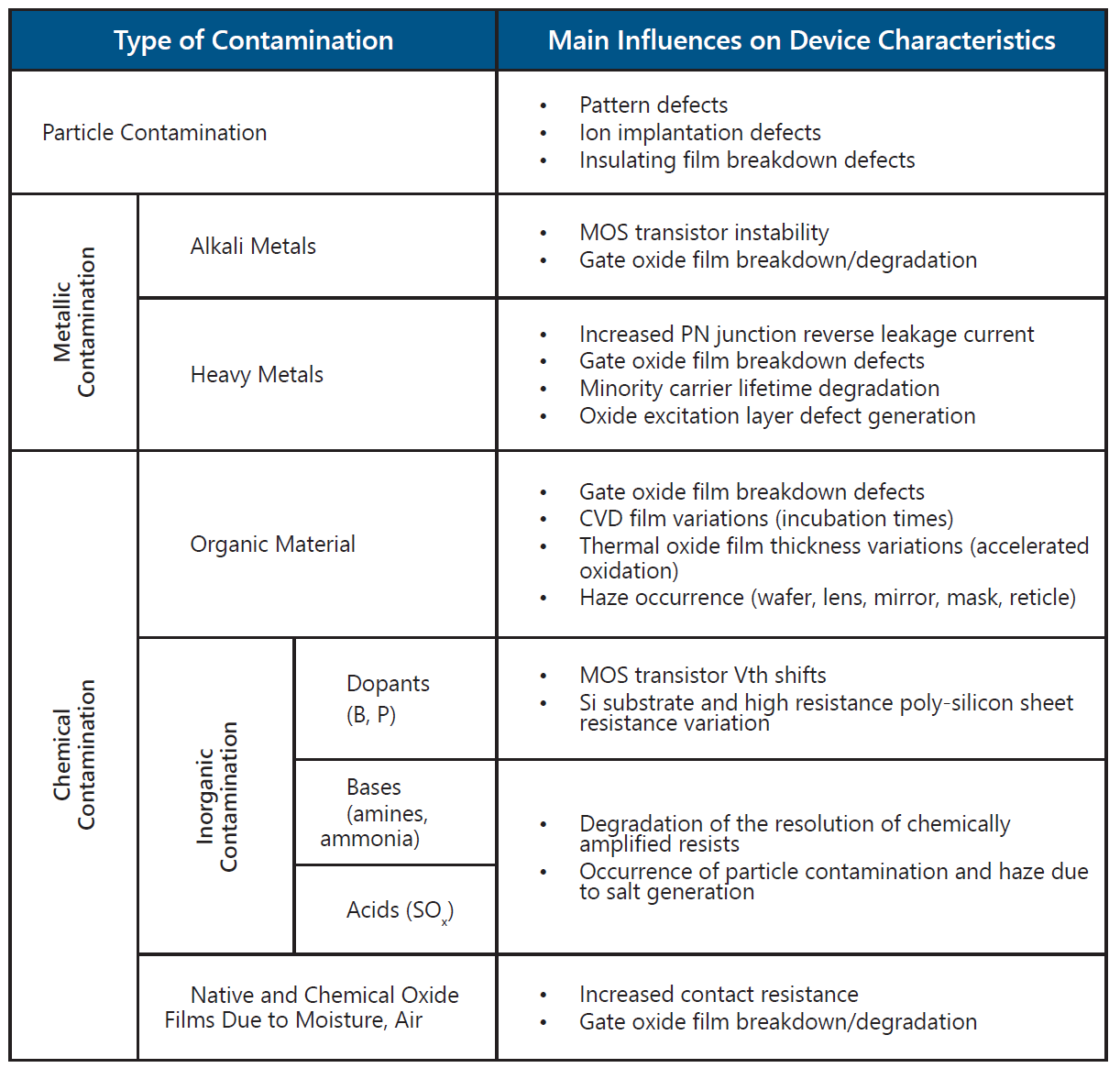
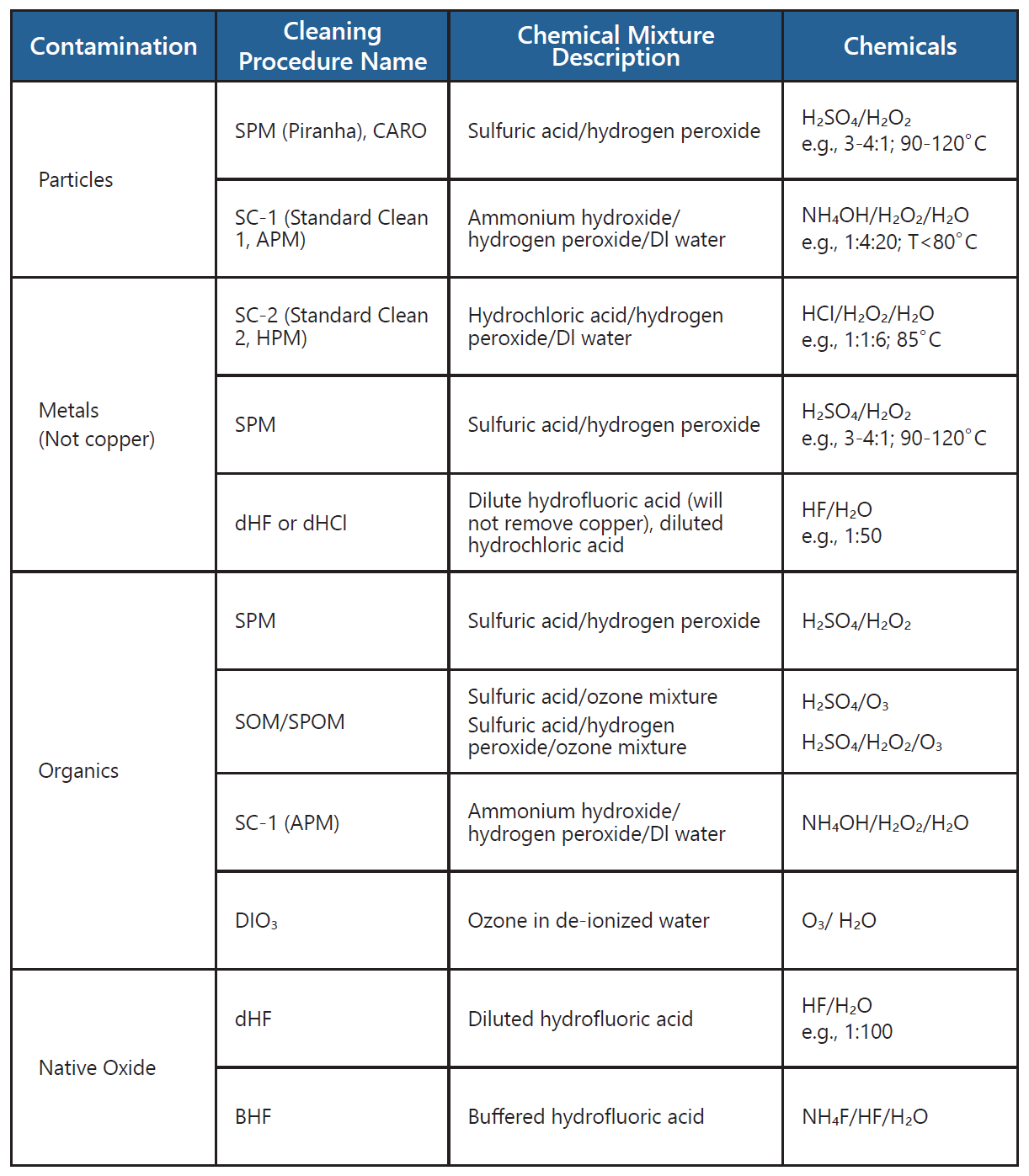
Surface contaminants on wafers may exist in the forms of adsorbed ions, elements, films, discrete particles, particle clusters and adsorbed gases. Figure 1 shows a schematic diagram of the types of surface contaminants present on the wafer before entering the processing flow. Table 1 describes the effects of different types of surface contaminants on device performance, and Table 2 shows the cleaning solutions used to remove different contaminants. Since gases are poor mediums for transporting contaminants, most of the cleaning work is carried out using liquids.
▼ Table 1. Surface Contaminants and Their Impact on Device Performance
▼ Table 2. Examples of cleaning solutions for CMOS process-prepared wafers
1. Particulate Pollution
Particle pollution may originate from dust in the air, and its sources include production equipment, process chemicals, the inner surfaces of gas pipelines, wafer transportation, vapor nucleation in film deposition systems, and operator activities. Even particles of low nanoscale size may cause "fatal" defects, either by physically blocking the formation of key features in the device (resulting in patterns, features, and injection defects), or by generating local electrical weaknesses in the insulating film.
The size of the particles needs to be 1/5 of the characteristic size to cause fatal defects. The cleaning scheme for particle contamination includes piranha cleaning for total particulate matter (containing organic substances) pollution and SC-1 cleaning for small and strongly adherent particles. The piranha solution is a strong acid that can oxidize many surface contaminants, generating soluble substances that can be removed from the solution. The SC-1 solution removes insoluble particles by oxidizing a thin layer of silicon on the wafer surface, then dissolving them into the solution and removing the adsorbed particles. The SC-1 solution prevents particle re-adsorption by inducing the same zeta potential (a measure of electrostatic repulsion) on the particles and the wafer surface.
All cleaning solutions containing hydrogen peroxide (SPM, SC-1, SC-2, SPOM) will leave a thin oxide layer on the surface of the silicon wafer. This layer can be removed by using HF in the final step. As an alternative, DIO₃ can be combined with HF for use.
II. Metal Pollution
Semiconductor devices are particularly sensitive to metal contaminants because metals have a high degree of fluidity within the silicon lattice (especially metals like gold). Therefore, they can easily migrate from the surface into the bulk silicon. Once inside the bulk silicon, moderate processing temperatures cause the metals to rapidly diffuse through the lattice until they are fixed at crystal defect sites. These "decorated" crystal defects reduce device performance, resulting in greater leakage current and a lower breakdown voltage.
Acidic cleaning agents (such as SC-2, SPM, dilute hydrofluoric acid, dilute hydrochloric acid and their mixtures) can be used to remove metal contaminants from the wafer surface. These solutions react with the metals, generating soluble ionized metal salts that can be washed away. One of the main sources of metal contaminants is the previous SC-1, so SC-2 is the subsequent step of SC-1.
III. Chemical Pollution
The chemical contamination on the surface of a wafer can be classified into three types: surface adsorption of organic compounds, surface adsorption of inorganic compounds, and thin (approximately 1-2 nm) natural oxides formed by the covalent bonding of silicon oxides or hydroxides.
3.1 Organic Compounds
Due to the presence of volatile organic solvents or cleaning agents, as well as the release of gases from polymer-containing building materials, organic compounds contaminate the surface of cleanrooms through air pollution or the residue of photoresist (PR). Such contamination is ubiquitous.
The severe contamination of organic compounds, such as the contamination that occurs when the photoresist is not completely removed, can form carbon residues during high-temperature processes, thereby affecting yield. These carbon-based substances can form atomic nuclei and manifest as particulate contaminants. A small amount of residual metal in the photoresist can be captured on the surface of the residues. Therefore, PR carbon residues need to be removed using SPM cleaning.
The organic contamination caused by ubiquitous volatile air pollutants also needs to be removed from the wafer surface. The presence of these pollutants can hinder the removal of natural oxides by the DHF solution (Figure 2), thereby creating an unclear interface between the gate oxide and the substrate and the gate. Poor interface quality can seriously reduce the integrity of the gate oxide. Additionally, the presence of surface organic compounds can affect the initial rates of thermal oxidation and CVD processes, thereby introducing unwanted and unpredictable variations in the film thickness.
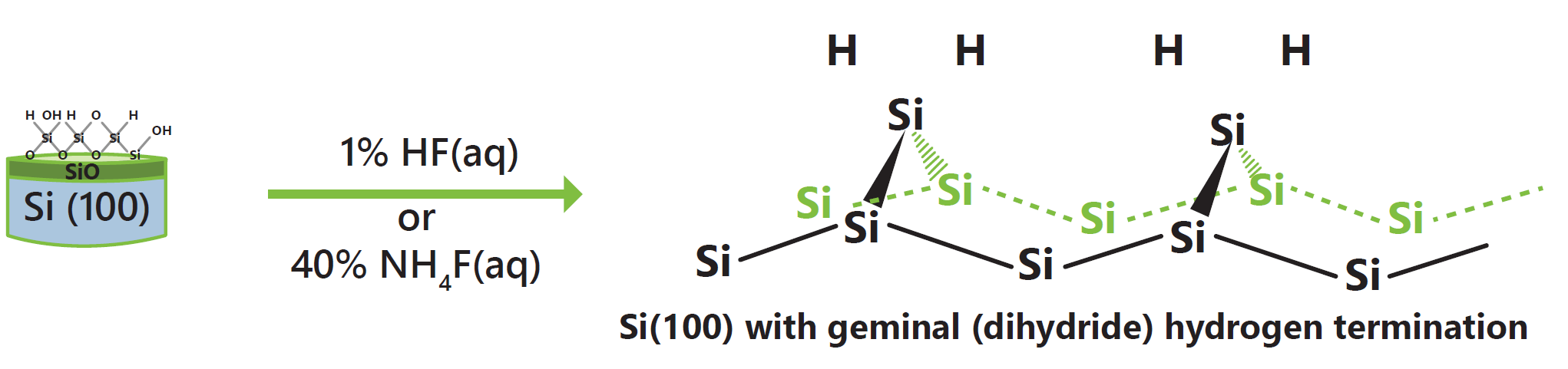
▲ Figure 2. Removal of natural oxides and surface characteristics of hydrogen-terminated surfaces
The SC-1 cleaning process removes these organic compounds through oxidation and solvation using hydrogen peroxide and ammonia. The SC-1 cleaning process gradually removes natural oxides, and the oxidation effect of hydrogen peroxide will generate new oxides to replace this layer.
In recent years, ozone dissolved in deionized water (DIO₃) has increasingly been used as an alternative to SPM and SC-1 cleaning solutions for removing organic pollutants, which is greener and safer. Depending on the nature of the organic contamination, combinations of SPM with ozone (SPOM) or SOM (sulfur ozone mixture) are also used. The allowable material loss and surface roughness are important parameters for selecting the appropriate cleaning method.
3.2 Inorganic Compounds
Inorganic compounds containing doping elements such as boron and phosphorus may exist on the surface of wafers due to the removal of phosphorus-based flame retardants or residual impurities from production tools. If these elements are not removed from the wafer surface before high-temperature processing, they may migrate into the substrate, thereby altering the resistivity.
Other types of volatile inorganic compounds, such as amines and ammonia (basic compounds) and sulfur oxides (SOx) (acidic compounds), if present on the wafer surface, can also cause defects in semiconductor devices. Acids and bases can cause unexpected changes in the pH of the chemical-developed photoresist, leading to problems with pattern formation and photoresist removal. These compounds are highly reactive. Due to the formation of chemical salts on the wafer surface, they can easily combine with other volatile environmental chemicals to form particles and haze. Through the combined action of SC-1 and SC-2 cleaning, the adsorbed acidic and basic substances can be removed from the wafer surface.
3.2 Natural Oxides
Like many elemental solids, silicon forms a thin layer of oxide on its surface through reactions with oxygen and water in the ambient air. The chemical composition of this layer is unclear; it is a random aggregation of Si-O-Si, Si-H, and Si-OH, in varying amounts.
The presence of such natural oxides on the silicon surface can cause problems in semiconductor device manufacturing, as it may increase the difficulty in forming very thin thermal oxide layers. Any natural oxides present on the wafer during the formation of thin gate oxides will weaken the electrical properties of the gate insulator by incorporating hydroxyl groups. Moreover, if natural oxides exist on the silicon surface of the contact pads, it will increase the contact resistance.
Over the past 50 years, our understanding of the properties of natural silicon oxides and their impact on device performance has significantly improved. These studies have shown that using deionized water, dilute hydrofluoric acid or ammonium fluoride, and polishing oxide etching solution (BOE) can completely remove the native silicon oxide and leave a hydrogen-terminated silicon surface (Figure 2).
In 1970, Werner Kern and his colleagues at RCA developed the first successful wet cleaning process for silicon wafers that was applied to the previous process (FEOL). Since then, this method has undergone many developments and successful modifications. The RCA cleaning process is still the main pre-cleaning process for FEOL in the semiconductor industry to this day.
The RCA cleaning process is a combination of the various steps mentioned above. It consists of continuous SC-1 and SC-2 solutions, followed by the addition of dilute HF solution or BOE to remove natural or chemical oxides. Some of the RCA cleaning processes are based on modifications developed by adding SPM or other steps.
Related News





 Follow Us
 +86-755-82984733
 sales@ecmg-global.net