

EMC Rectification Method - "Eliminate Interference Sources" & "Block" & "Diversify"
When it comes to the rectification of EMC, we often refer to the three elements of EMC, namely the source of interference, the path of interference, and the interfered component.
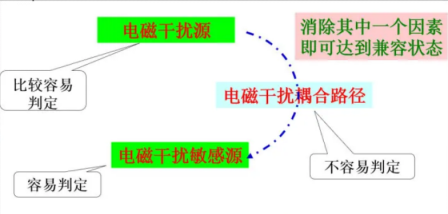
The interference source can often be identified through near-field probes and the elimination method. The interference path is usually difficult to determine. Interference is generally classified into common-mode interference and differential-mode interference.
Common-mode interference can be classified into three types: voltage-driven, current-driven, and magnetic coupling. The most typical case of voltage-driven interference is when the interference radiates outward through coupling to the heat sink. The typical case of current-driven interference is when it is coupled to other circuits through a common impedance. Magnetic coupling is relatively common. Any current loop will form a coupling. The difference is that a constant current forms a constant magnetic field, and a constant magnetic field will not form an electric field. A changing current forms a changing magnetic field, and the interference is more obvious. The latter is also common in circuits.
Common-mode interference can be calculated using the formula S*I*f*f/D. (This formula is for reference only. Rectification can be carried out in this direction.) Here, S represents the loop area, I represents the current magnitude, f represents the interference frequency, and D represents the distance from the interference source to the interfered source.
Based on years of experience in rectifying EMC issues, in light of the above analysis, the rectification direction can be determined by "eliminating interference sources", "blocking", and "diversion", and this can serve as a technical guideline.
In my opinion, eliminating the interference source is the simplest method for rectifying EMC issues and can achieve a permanent solution. The elimination of interference sources can be divided into several methods: spread spectrum, "frequency hopping", active clamping absorption, passive RC absorption circuit. Spread spectrum involves expanding the frequency difference to disperse the energy. It should be noted that for the fundamental frequency, as the resonance multiplier increases, the effect becomes more and more obvious. The width of the spread will be wider. That is, if the frequency of 100KHz is subjected to spread spectrum processing, then the resonant spread spectrum effect at 500KHz will be more obvious than that at 100KHz.
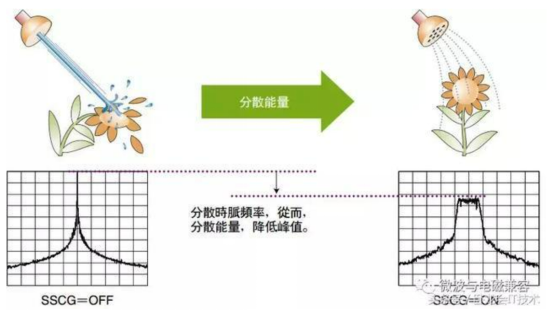
"Frequency hopping" means adjusting the interfering frequency to avoid the tested frequency band. However, it should be noted that the entire frequency band needs to be re-tested to prevent the occurrence of other frequency bands exceeding the standard. Commonly, when testing the low-frequency band, radiation exceeds the standard due to the switching power supply. By increasing the frequency of the switching power supply, this frequency band can be avoided. The RC absorption circuit is mainly used to absorb the LC resonant circuit (the design of the RC resistance value can refer to the following link #I said# #First post# RC snubber circuit design calculation - Planet - Power Supply Network (dianyuan.com)).
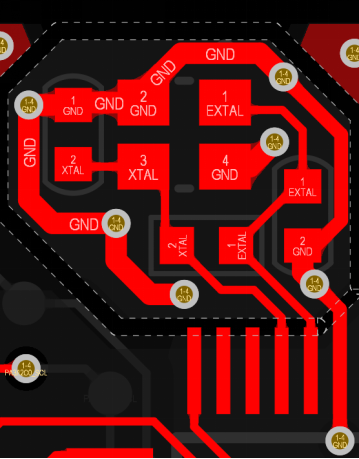
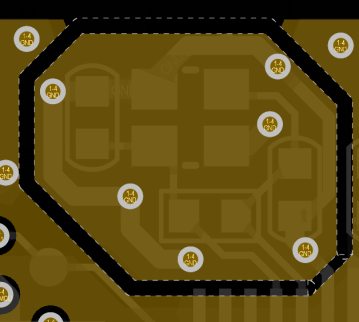
2. "Blocking" - Ignoring the interfering sources for now, the next direction we need to focus on for rectification is whether it should be "blocking" or "dilution". This may seem simple, but it can help us determine the rectification direction and prevent the use of various rectification methods haphazardly, only to end up with no progress at all. The EMC rectification itself is a significant test of an individual's comprehensive ability. It may take a month or even longer, but still no progress. Therefore, determining the direction during rectification is extremely important. For "blocking", the essence is to block the interference paths. Interference paths usually include common impedance interference, inductive coupling, capacitive coupling, and spatial radiation. Blocking common impedance interference means increasing the impedance of the external path of the interfering source. This usually involves series magnetic beads on the power output, resistors in the signal output branch, and typical cases include handling the ground of the crystal oscillator. By doing this, one can adopt the method of drilling holes in the area and grounding it at a single point to prevent the interference from flowing into the ground. At the same time, leave a ground plane on the corresponding other layer to provide a circuit:
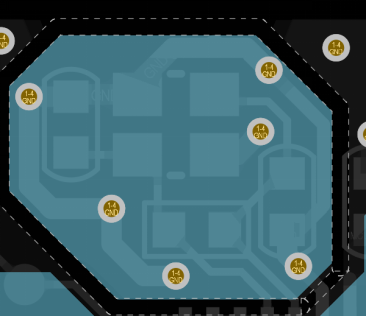
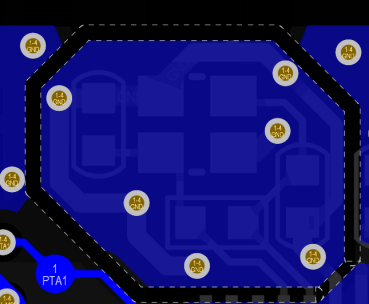
The "blocking" measures for capacitive coupling include increasing the distance between the interfering source and the interfered source, reducing the effective coupling area between the interfering source and the interfered source, and choosing materials with a lower dielectric constant to be placed between the interfering source and the interfered source; the "blocking" measures for inductive coupling include increasing the distance between the interfering source and the interfered source, reducing the effective coupling area between the interfering source and the interfered source, adjusting the directions of the interfering source and the interfered source, for example, if the magnetic field directions of the two sources are perpendicular to each other, it can achieve the effect of blocking inductive coupling; for "blocking" of space radiation, the most effective method currently is to ground a metal shielding cover. In essence, electromagnetic shielding also belongs to eliminating the interfering source, because electromagnetic shielding actually causes impedance mismatch, thereby forming reflection loss, insertion loss, and re-reflective loss.
"Shu" also serves as a guide, that is, it guides the interference source to the desired location. This is exactly the opposite of blocking. Common measures include increasing the grounding area, reducing the circuit impedance, shortening the distance of the coupling path, and increasing the filter capacitors for power/signal output, etc. Let's analyze this with an actual case below.
1.) Product Information
:
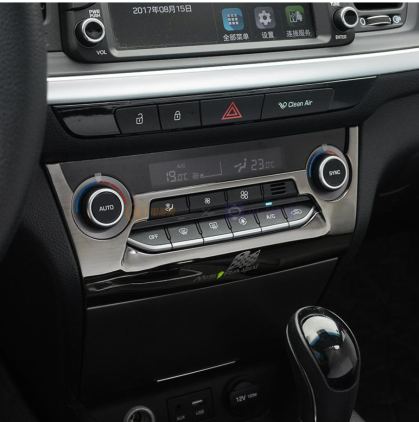
Vehicle-mounted display screen
2.) Diagram of Experimental Setup:
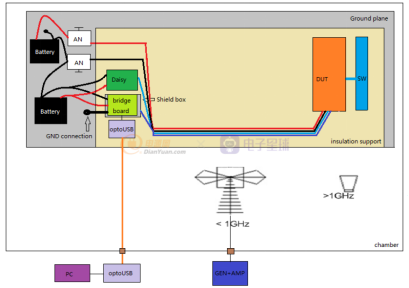
3.) Experimental Phenomenon:
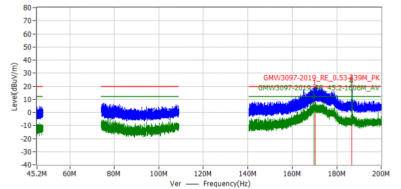
During the test of 45 MHz to 200 MHz, it was found that the peak value in the 180 MHz to 200 MHz range exceeded the standard.
4.) Phenomenon Analysis
This frequency band is considered to be beyond the bandwidth limit, as shown in the circular area in the figure. The common sources of interference are power supply, data signal and ground. We attempted to scan the product using a near-field probe and found that there is an envelope ranging from 160 MHz to 200 MHz above the switching power supply. The circuit diagram of this part is as follows:
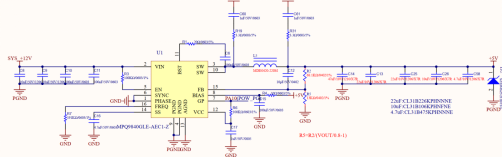
Regarding the exceeding of this frequency band, we adopted the "dilution" approach to solve the problem. We reduced the loop area and selected ceramic capacitors at the power output end for filtering. This not only prevents interference from entering the next stage of the capacitor, but also reduces the loop area and interference. Since the exceeding frequency band is around 160 MHz - 180 MHz, referring to the impedance characteristic curve of the capacitor:
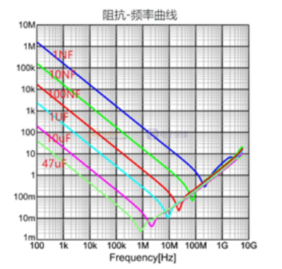
For the 160 MHz component exceeding the standard, a 1nF capacitor can be used for filtering. However, the original circuit design does not include this filtering capacitor. We have chosen to add three of these capacitors at the load output end. By using multiple capacitors of the same capacitance value in parallel, the ESR can be reduced, achieving a better filtering effect. At the same time, it should be noted that when selecting capacitors, it is best to place them in a 10-fold ratio. Otherwise, obvious anti-resonance points may easily occur. Re-testing this frequency band shows the following results:
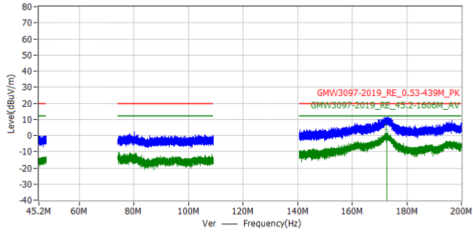
The frequency range of 160MHz - 180MHz can comply with this testing standard. However, considering the cost factor, it is necessary to conduct comparative analysis tests on individual, two, three, and four capacitors. If single or two capacitors are used, even when testing multiple samples, it can still pass the test and have sufficient margin (at least 2-3db). In such cases, single or two capacitors can be selected.
Summary: When dealing with EMC issues, one needs to repeatedly practice and summarize in actual situations. Over time, a set of one's own theoretical framework will naturally form. Due to my limited personal ability, there may be some shortcomings. I sincerely hope that everyone can kindly offer corrections. Thank you.
Related News







 Follow Us
 +86-755-82984733
 sales@ecmg-global.net