
SEMI Standards Introduction - 20201020
Introduction to SEMI Standards
Since its establishment 50 years ago, SEMI has been dedicated to the formulation of international standards. There are over 1,300,000 volunteers worldwide in SEMI, from 2,260 companies, engaged in SEMI's international industrial technology standard activities. They represent the voices and demands of industries all over the world. Currently, SEMI has established 20 standard excellence committees and 216 working groups to contribute to the formulation of global industrial standards. To date, 1,010 standards and safety-related guidelines of 16 categories have been formulated and widely applied by global IDM factories, wafer factories, and packaging and testing factories.
SEMIS Series Standard Introduction
The SEMI certification assessment for semiconductor equipment is based on the S series of global industry standards and guidelines formulated by the SEMI International Standard Environmental Health and Safety Committee (EHS TC). It is applicable to semiconductor materials and manufacturing equipment and is a necessary specification requirement for equipment in the semiconductor industry. It can effectively reduce hazard risks. The SEMI S series standards were first introduced in 1986, among which SEMI S2 was published in 1991. After annual updates and revisions, the latest English version S2-0818E was released in December 2018. The semiconductor industry adopts a wide range of prevention and management measures to reduce risks. The SEMI S series standards aim to provide guidelines for environmental, health, and safety aspects for semiconductor equipment. The content covers equipment installation guidance, exhaust gas treatment, hazard warning labels, liquid heating systems, ventilation and exhaust, qualification assessment, ergonomics, hazard assessment, equipment purification, safety manual, fire safety, safety interlock system electronic design, ionizing radiation, laser radiation levels, noise pollution levels. The SEMI standards are widely applied in the production, testing, and integration of semiconductor products. The most typical measure is to include SEMI S2 safety compliance certification, SEMI F47 voltage sag, and SEMI S23 energy efficiency as essential specifications when purchasing equipment systems.
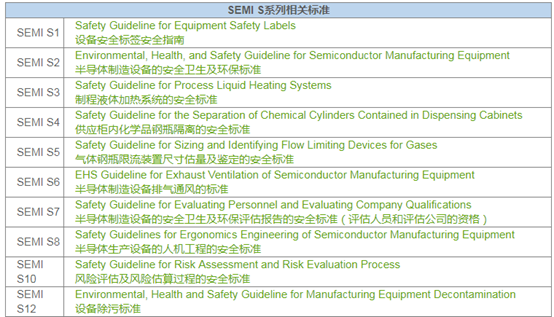
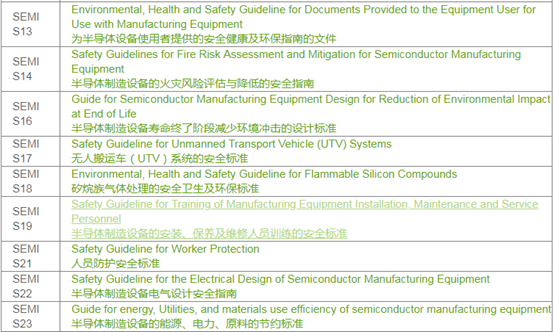
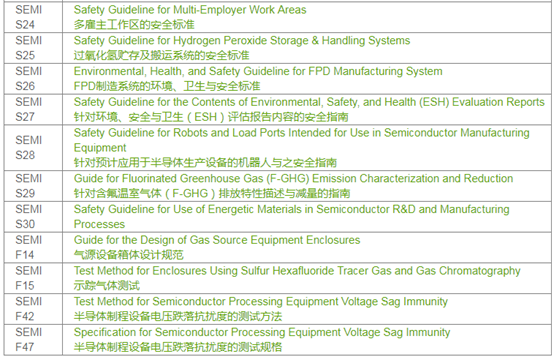
The significance of SEMI standard certification:
The SEMI S series standards have a profound impact on the safety and sustainable development of the semiconductor industry. Meeting SEMI requirements not only complies with international regulations but is also the main criterion for mainstream chip manufacturers to select machine equipment, serving as a safety standard. SEMI certification has been widely recognized by major international wafer manufacturers such as Intel, TSMC, and TEL. SEMI certification has become an internationally accepted and widely recognized passcode in the industry chain. International wafer manufacturers all require equipment and subsystem manufacturers to provide SEMI standard certification certificates. Leading domestic semiconductor manufacturers such as NAURA, SME, and AMEC have all passed SEMI certification. Meeting SEMI standards not only complies with international regulations but is also one of the necessary conditions for the semiconductor industry.
SEMI S2 Equipment Safety Assessment:
SEMI S2 sets out the environmental, health and safety standards for semiconductor manufacturing equipment, covering various safety areas such as electrical, mechanical, fire protection, chemistry, radiation, noise, and shock resistance. It represents the basic safety requirements for the global semiconductor industry.
SEMI S6 Standard for Exhaust Ventilation of Semiconductor Manufacturing Equipment:
If the exhaust ventilation design is not reasonable, it may lead to casualties, damage to equipment, and even the total destruction of the factory. Equipment suppliers should provide effective exhaust ventilation designs to protect personnel, equipment and the environment from risks. The optimization of exhaust ventilation is of great importance.
SEMI F47 Voltage Drop Resistance Test for Semiconductor Manufacturing Equipment:
The semiconductor manufacturing industry suffers an annual economic loss of over 100 million US dollars due to voltage drops. To prevent more than 90% of the problems caused by power voltage drops in the semiconductor manufacturing process.
Related News



 Follow Us
 +86-755-82984733
 sales@ecmg-global.net