

SEMI F47 Certification Q&A
1. What suggestions do you have regarding the tolerance of semiconductor equipment to fluctuations in the SEMI F47 test power supply?
In response to power fluctuations, if it is desired that the equipment has resilience,
1. During the initial equipment design phase, the selection of components at the power supply end requires that the components must have the ability to withstand voltage fluctuations, and even meet the requirements of SEMI F47.
The following aspects are recommended to be given priority consideration during the design process:
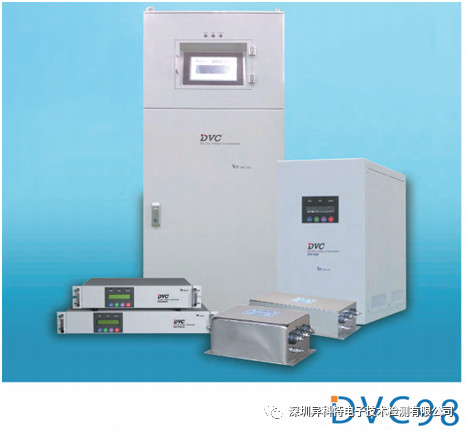
1) Directly adding a voltage compensation device, such as DV98, to the main input power circuit. This method has a relatively high cost and is generally not recommended.
2) Through the F47 test, identify the components that are sensitive to under-voltage, such as the control circuit. Select those components that require targeted compensation devices. This approach results in relatively lower costs. In contrast, for heating components and mechanical parts like motors, they are less sensitive to under-voltage and thus do not require compensation devices.
3) For contactors, circuit breakers and relays, choose those with a wide voltage range that are not sensitive to voltage sags, or select those that meet the requirements of F47 testing.
4) For some key power modules and control components, it is necessary to select those that have F47 certification or have a wide voltage range, such as switching power modules and servo drivers.
Two, what are the differences between SEMI F47 and Samsung standard tests?
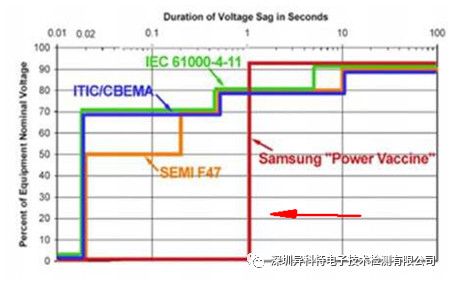
1. SEMI F47 specifies the following: for each input power supply, a drop test is conducted.

2. The test waveform for SAMSUNG is as follows: It is required to simultaneously cut off power to all phase inputs for 1 second.
Three, How do the equipment meet Samsung standards?
Regarding this issue, theoretically, the following several recommended approaches are available:
1) The equipment complies with the F47 requirements and is in line with the agreement with Samsung. Can they accept this? If not, we should discuss with them whether we can use the UPS already available in the production line to meet Samsung's requirements.
2) After installing the UPS, the equipment meets the F47 standard and complies with Samsung's requirements. However, this is generally applicable to single-phase small devices. However, the presence of the UPS in the product itself conflicts with Samsung's requirements, and it is necessary to negotiate with Samsung to determine if this is acceptable.
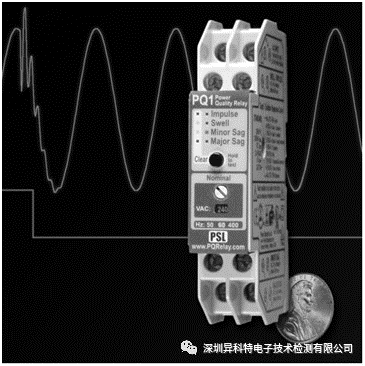
3) Install a power quality sensing device for the equipment to monitor fluctuations and interference in the power supply and feed back the signals to the equipment. However, it is necessary to ensure that the computer control circuit of the equipment is connected to Samsung's UPS network and the equipment software needs to be adjusted. That is, when the 1S power fails, it is necessary to ensure that the system can automatically restart without the intervention of an operator. This method is currently used less frequently and requires discussion and agreement with Samsung before implementation.
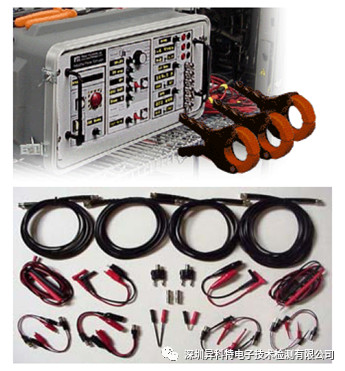
The power sensing device is as follows:
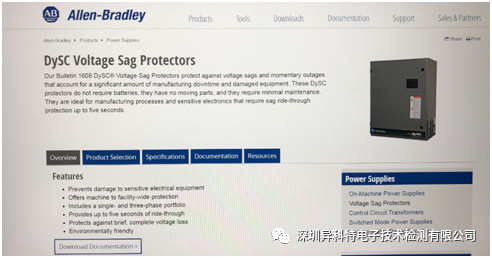
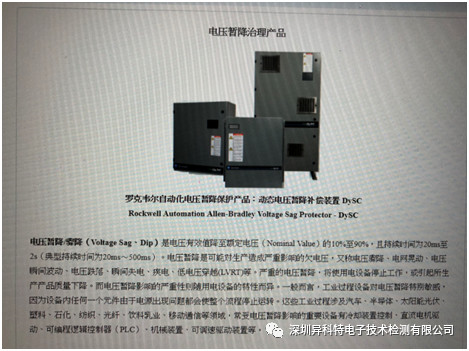
Based on our previous certification cases, if one wants to meet the requirements of the Samsung Power Vaccine, merely having the components of the device meet the standards is not sufficient to meet this testing requirement. Special professional voltage compensation devices need to be installed at the power supply end of the device. The following three manufacturers' devices have been used by customers and can be compared and selected:
Four, what are the differences between the voltage sag (DIP) testing equipment and the SEMI F47 testing equipment?
1. The testing capabilities and positioning of the instruments are different.
The semiconductor IPC testing equipment is specifically designed for the SEMI F47 test in industrial semiconductor testing. It can accurately test the requirements of semiconductor manufacturing equipment regarding the SEMI F47 standard. The test voltage range is 100 to 480 VAC, with a frequency of 50/60 Hz, single-phase and three-phase. The continuous load current can reach 200 A per phase. The DIP single-phase equipment for CE certification is designed for voltage sag testing of ordinary electronic consumer products. It can only meet a load of less than or equal to 16 A. For three-phase, the maximum can only be below 30 A per phase. This is because full-load testing causes significant equipment damage. Therefore, in many cases, DIP testing is conducted under unloaded or reduced-load conditions to protect the instrument.
2. The IPC device can generate a genuine relative phase voltage sag, while the ordinary DIP device can only produce an analog relative phase voltage sag.
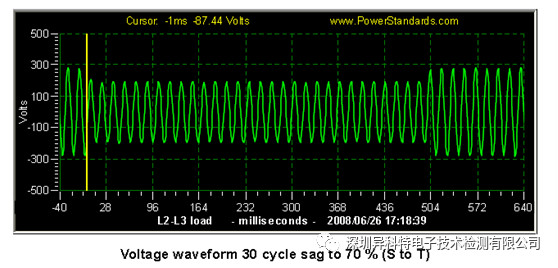
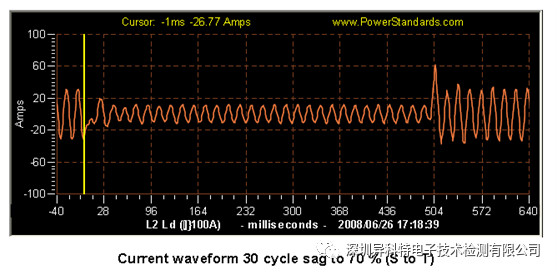
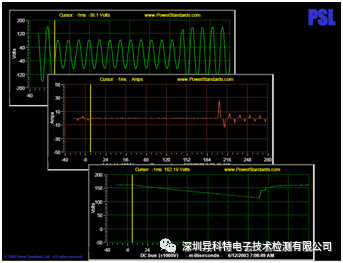
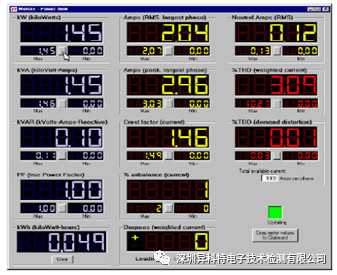
3. IPC can record voltage and current waveforms in real time, as shown in the figure below. However, most DIP devices do not have this function.
4. IPC has 28 independent auxiliary test channels and accessories, which can test and monitor any power module of industrial equipment, helping manufacturing plants quickly locate the fault points. Generally, DIP devices do not have this function and can only test the main power circuit. Because DIP instruments need to be connected in series before the source and the tested equipment, a very large current will be generated during voltage fluctuations. DIP usually reduces the actual load for testing, which does not meet the SEMI F47 requirements.
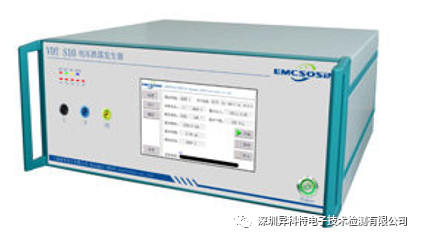
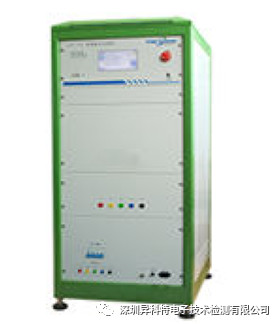
The DIP testing instruments used for CE certification are available from many brands both domestically and internationally. Their principles and testing capabilities are the same.
Related News







 Follow Us
 +86-755-82984733
 sales@ecmg-global.net