

Introduction to Common Antennas Used in EMC and RF Testing and Basic Concepts - 1
Antennas are widely used in EMC and RF testing and measurement. The commonly used antennas are as follows:
2. Double-cone antenna:
It is commonly used in the RSE substitution test.
Common working frequency band: 30 MHz to 300 MHz
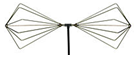
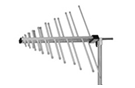
2. Logarithmic Antenna:
It is commonly used for NSA calibration in radiation sites.
Common working frequency band: 30 MHz to 1 GHz
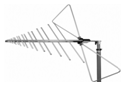
3. Log-periodic antenna:
It is commonly used for testing radiation interference/radiation spurious low-frequency signals.
Common working frequency band: 30 MHz to 3 GHz
4. Three-ring Antenna:
It is commonly used for testing the magnetic field radiation of lighting products.
Common working frequency band: 9KHz - 30MHz

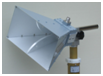
5. Horn Antenna:
It is commonly used for testing radiation interference/radiation stray frequencies.
Common working frequency range: 1GHz to 18GHz
6. Dipole Antenna:
It is commonly used in the measurement of site attenuation and antenna coefficients.
Common working frequency band: 30 MHz to 4 GHz
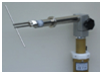
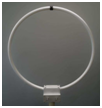
7. Ring Antenna:
It is commonly used for low-frequency magnetic field testing.
Common working frequency band: 9KHz - 30MHz
During the EMC and RF testing process, the following several basic concepts need to be understood:
The polarization direction of the antenna
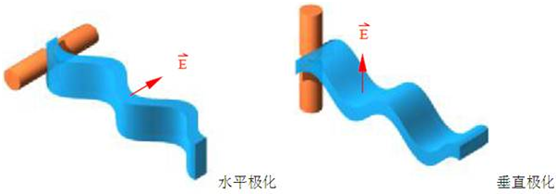
Often, customers ask what is vertical and what is horizontal. Antennas radiate electromagnetic waves into the surrounding space. Electromagnetic waves are composed of electric fields and magnetic fields. People have stipulated that the direction of the electric field is the polarization direction of the antenna. The antennas commonly used are single-polarized. The following figure illustrates two basic cases of single-polarization.
2. Beam Width
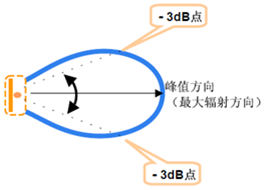
The beam width refers to the angle between the two half-power points in the direction of the antenna's peak response. The beam width has two components, E-plane and H-plane, and they are not necessarily exactly equal. If the gain of a certain antenna is designed to be positive, its beam width and gain are often exactly opposite. The radiation pattern usually has two or more lobes, among which the lobe with the maximum radiation intensity is called the main lobe, and the remaining lobes are called side lobes or off-lobes. The angle between the two points where the radiation intensity drops by 3 dB (power density is halved) on both sides of the main radiation direction is defined as the beam width (also known as beam width, main lobe width or half-power angle). The narrower the beam width, the better the directionality, the farther the effective range, and the stronger the anti-interference ability.
3. Antenna Gain
Gain refers to: under the condition where the input power is the same, the ratio of the power density of the signal generated by the actual antenna and the ideal radiation unit at the same point in space. It quantitatively describes the degree to which an antenna concentrates the input power for radiation. Gain is obviously closely related to the antenna pattern. The narrower the main lobe of the pattern and the smaller the side lobes, the higher the gain. The physical meaning of gain can be understood as follows - to generate a certain size of signal at a certain point within a certain distance, if an ideal non-directional point source is used as the transmitting antenna, 100W of input power is required, while using a directional antenna with gain G = 13 dB = 20 as the transmitting antenna, the input power only needs 100 / 20 = 5W. In other words, the gain of a certain antenna, in terms of the radiation effect in its maximum radiation direction, compared to the non-directional ideal point source, is the multiple by which the input power is amplified.
4. Antenna Coefficient (AF)
The antenna coefficient in free space is an inherent parameter of the antenna itself. The antenna coefficient represents the relationship between the radiation field of the antenna and the input voltage of the antenna. There is the following relationship between AF and gain:
AF=E/U
(E - Electric field intensity of the uniform plane wave incident on the reference plane of the receiving antenna; U - Output voltage of the receiving antenna)
5. Bandwidth
Bandwidth refers to the frequency coverage range of an antenna. If the bandwidth is expressed as a portion of the antenna's rated frequency range, the bandwidth of an inharmonic antenna is greater than that of a harmonic antenna, and the bandwidth of a low-gain antenna is greater than that of a high-gain antenna. For antennas used in broadband, balanced and unbalanced converters or matching networks, their bandwidth is more affected by the antenna coefficient.
6. Impedance
The impedance of the antenna is usually not considered much, because the load impedance of all EMC test equipment is designed to be 50Ω. The impedance of the EMC antenna is usually also designed to be inductively calibrated to be close to 50Ω within its frequency range. However, testers should also be aware of the possible problems caused by impedance mismatch, especially for low-frequency magnetic loop antennas. The impedance of the antenna often changes with frequency, but many low-frequency loop antennas do not have a matching network to compensate for this change.
7. Voltage Standing Wave Ratio (VSWR)
Standing wave ratio (VSWR) is an indirect parameter used to measure whether the impedances of two RF devices are matched. VSWR is very important for most users for several complex reasons. To put it simply, in normal circumstances, the impedance exhibited by the feeder is the sum of the rated impedance of the feeder and the load impedance. Therefore, impedance mismatch may occur at both ends of the feeder, causing most signals to be reflected at the load, and then reflected again along the feeder at the source. When precise measurement is required, or when the signal source is very sensitive to impedance mismatch, or when the loss of the feeder is very high, VSWR becomes a problem.
8. Size
Size is a very important characteristic of an antenna. The need to control and move the antenna limits the actual size of the antenna. The requirement to use the antenna in a shielded room also restricts its maximum size. Reducing unwanted coupling to the ground or surrounding objects will also affect the size. However, on the contrary, if one desires the antenna to have good low-frequency response, high gain, or wide bandwidth, the size of the antenna needs to be increased.
Related News







 Follow Us
 +86-755-82984733
 sales@ecmg-global.net