

The Radio Department of the International Telecommunication Union has released the 6G framework and overall goal proposal.
From June 12th to 22nd, the 44th meeting of the 5D Working Group of the Radio Communication Department of the International Telecommunication Union (ITU-R WP5D) was held in Geneva, Switzerland. The ITU successfully completed the "Recommendation on the Framework and Overall Goals for IMT for 2030 and Beyond". This recommendation serves as a guiding document for 6G, gathering global consensus on 6G vision, depicting the goals and trends of 6G, and proposing typical scenarios and capability indicator systems for 6G.
6G Goals and Trends
The proposal suggests that the 6G system for the period up to 2030 and beyond will drive the realization of seven key goals: inclusiveness, ubiquitous connectivity, sustainability, innovation, security, privacy and resilience, standardization and interoperability, and interoperability. This will support the construction of an inclusive information society and help achieve the United Nations' sustainable development goals.
6G will enable the connection between humans, machines and objects, as well as the connection between the physical world and the virtual world. At the same time, it is expected to integrate perception and artificial intelligence capabilities into the network, becoming a new type of digital infrastructure that can carry new users and empower new applications. 6G users and applications will exhibit nine major trends: ubiquitous intelligence, ubiquitous computing, immersive multimedia and multi-sensory communication, digital twin and extended reality, intelligent industry, digital healthcare and health, ubiquitous connection, integration of perception and communication, and sustainability.
6G typical scenarios
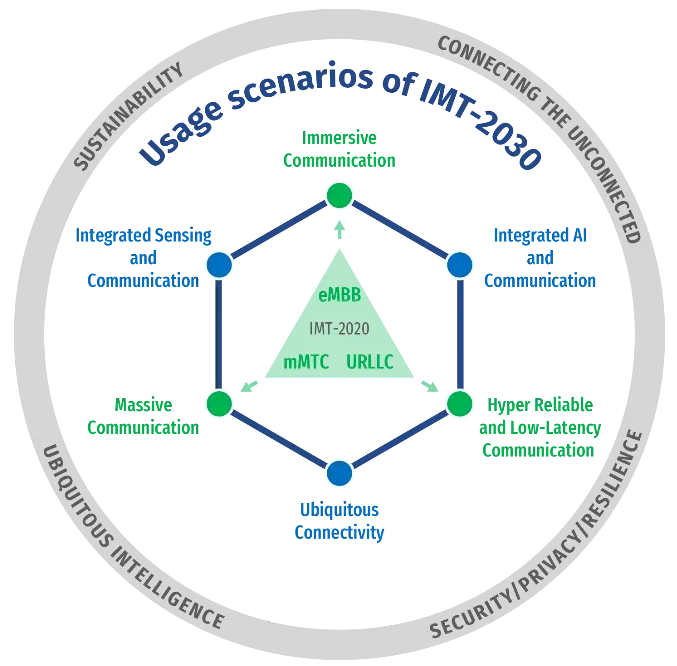
In terms of typical scenarios, 6G will enhance and expand upon the three major scenarios of 5G, including immersive communication, ultra-large-scale connectivity, extremely high reliability and low latency, the integration of artificial intelligence and communication, the integration of perception and communication, and ubiquitous connectivity. Additionally, six major scenarios of 6G have been proposed, namely sustainability, security/privacy/elasticity, connecting unconnected users, and ubiquitous intelligence for improving the overall system performance.
6G capability indicator system
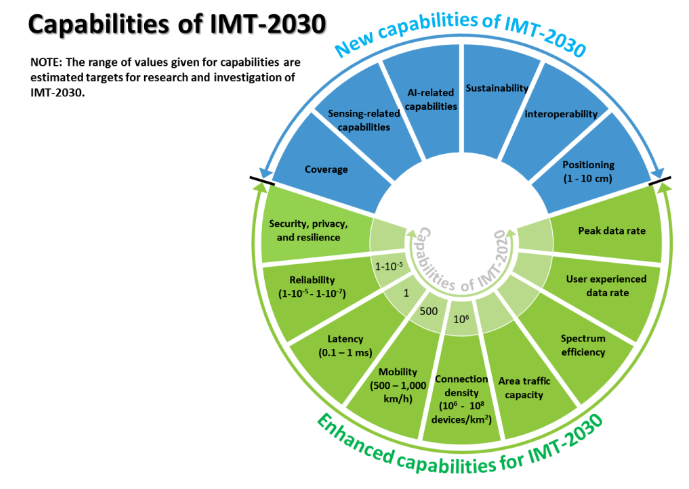
The proposal defines 15 capability indicators, namely connection density, mobility, latency, reliability, positioning accuracy, peak rate, user experience rate, spectral efficiency, regional traffic density, perception-related indicators, AI-related indicators, security and privacy resilience performance indicators, sustainability performance indicators, coverage, and interoperability.
Related News







 Follow Us
 +86-755-82984733
 sales@ecmg-global.net