

The differences between EMC, EMI and ESD - essential knowledge for beginners!
ESD, EMI, and EMC design are common challenges faced by electronic engineers during the design process. Electromagnetic compatibility (EMC) refers to the ability of a device or system to operate within its electromagnetic environment in accordance with the required standards and not to cause intolerable electromagnetic interference to any devices in the environment.
Therefore, EMC involves two aspects of requirements: Firstly, during normal operation, the electromagnetic interference generated by the equipment to the surrounding environment should not exceed a certain limit; Secondly, the appliance should have a certain degree of immunity to the electromagnetic interference existing in the surrounding environment, that is, electromagnetic sensitivity. The term "electromagnetic interference" refers to any electromagnetic phenomenon that can degrade the performance of equipment or systems. And the term "electromagnetic disturbance" refers to the performance degradation of equipment or systems caused by electromagnetic interference.
EMC consists of two parts: EMI (Electromagnetic Interference) and EMS (Electromagnetic Susceptibility). EMI refers to the electromagnetic noise generated by the machine itself during its normal operation that is detrimental to other systems; while EMS refers to the machine's ability to perform its normal functions without being affected by the surrounding electromagnetic environment.
In the design of electronic products, to achieve good EMC performance and cost-effectiveness, it is crucial to conduct EMC design for the products; the EMC performance of electronic products is a result of the design. Testing merely represents the inherent EMC performance of the electronic products using some quantitative methods. Regarding EMC design:
First of all, EMC design should be considered in the early stage of research and development.
If the EMC issue is not taken into account during the early stage of product design and only the hope is placed on resolving it during the testing phase (manifested as rectifying the design of the final product to solve its EMC problems, resulting in a significant investment of human and material resources in the later testing/verification and rectification stages), then even if the product rectification is successful, in most cases, the research and development costs will increase significantly and the development cycle will be prolonged. Only by considering and predicting the EMC issue during the early product design process, treating EMC as a controllable design technology and integrating it concurrently and synchronously with the product function design process, can the product be designed well in one go.
Secondly, EMC design should be carried out systematically.
Improving the EMC performance of electronic products through design is definitely not something that can be accomplished by just one EMC expert within the company. Because EMC cannot exist independently of the physical aspects of the product, such as its hardware and structure. Therefore, in order for the designed electronic products to achieve good EMC performance at once, it is necessary to enhance the EMC experience and awareness of the product design engineers.
For hardware engineers, in addition to the circuit design knowledge they must already possess, they should also master the basic knowledge of EMI and EMS anti-interference design; PCB design engineers need to acquire the EMC design knowledge related to component layout, layer stacking, and high-speed wiring; structural engineers also need to understand the design knowledge regarding product structure's shielding and other aspects. Because these engineers who jointly participate in product design need to implement the suggestions proposed by FMC experts during the product design process, they must understand and grasp the secrets of the suggestions put forward by EMC experts, and combine them with the design characteristics of their respective fields to eliminate all potential EMC problems at the product design stage. Only when all the development personnel involved in product design jointly improve their EMC quality can high-performance EMC electronic products be designed.
When designing general electronic products, if the EMC issue is not taken into consideration, it will lead to failure in the EMC test, and thus the products will not be able to pass the relevant regulations' certification. The following figure outlines the key points of EMC, EMI and ESD reviews.
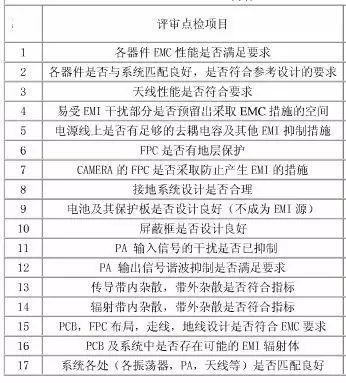
(Key points of EMC, EMI and ESD reviews)
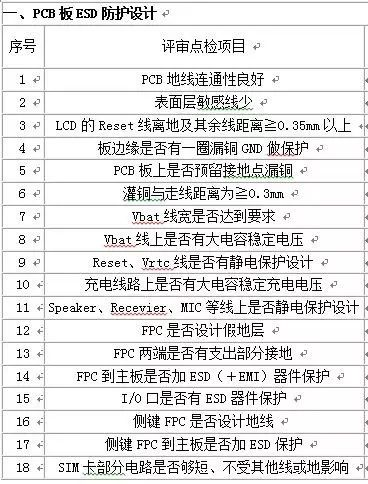
(Key points of EMC, EMI and ESD reviews)
With the development of electrical and electronic technology, household appliances have become increasingly popular and electronicized. The increasingly advanced broadcasting and television, postal and telecommunications, and computer and network technologies have made the electromagnetic environment increasingly complex and deteriorated. This has led us to pay more attention to the working environment of equipment and to increasingly focus on the impact of the electromagnetic environment on electronic devices. The issues of electromagnetic interference (EMI) and electromagnetic compatibility (EMC) of electrical and electronic products have received increasing attention from engineers and manufacturing enterprises.
In ESD protection, it can be generally divided into two major categories:
Conductive ESD protection
For the protection of static electric current in circuits, some protective devices are mainly used. A protective circuit is formed at the front end of sensitive components to guide or dissipate the current. Such protective devices include: ceramic capacitors, varistors, TVS diodes, etc.
2. Radiation-resistant ESD Protection
The field generated by static electricity has an impact on sensitive circuits. The main protective method is to minimize the generation and energy of the field. By improving the structure, the protective capability can be enhanced, and protection measures can be implemented for sensitive circuits. Protecting against the field is usually quite challenging. In the process of improvement, a method called equipotential body has been explored. By effectively connecting, the shell forms a body with the same potential, suppressing discharge. It has been proven that this method is effective and easy to implement.
There are many general methods for preventing static electricity, including reducing the accumulation of static electricity; insulating products to prevent the occurrence of static electricity; providing branch circuits to divert the static current; shielding circuits in discharge areas; reducing the loop area to protect the circuit from the magnetic field generated by static discharge. There are methods for direct discharge as well as coupling for associated fields.
Related News







 Follow Us
 +86-755-82984733
 sales@ecmg-global.net