

The Ministry of Industry and Information Technology has publicly solicited opinions on the "Notice (Draft for Comment) on Conducting Tests on the IPv6 Protocol Support Capability of Wireless Local Area Network Devices in Model Approval Procedures"
In order to thoroughly implement the spirit of the 20th National Congress of the Communist Party of China, accelerate the construction of a network power, and solidly promote the in-depth development of the large-scale deployment and application of IPv6, in accordance with the "Regulations on Radio Management of the People's Republic of China" and the "Notice on Strengthening and Regulating Radio Management of the 2400 MHz, 5100 MHz and 5800 MHz Frequency Bands" (No. 129 of 2021 from the Ministry of Industry and Information Technology), the Ministry of Industry and Information Technology intends to conduct capability tests on wireless local area network devices that support the IPv6 protocol (hereinafter referred to as "IPv6 wireless local area network devices") in the model approval of radio transmitting equipment (hereinafter referred to as "model approval"). The specific requirements are as follows: "Notice of the Ministry of Industry and Information Technology on Matters Concerning Conducting Capability Tests on Wireless Local Area Network Devices Supporting the IPv6 Protocol in Model Approval (Draft for Comment)".
In order to carry out the relevant work properly, the Ministry of Industry and Information Technology has publicly solicited opinions from all sectors of society. If you have any suggestions or opinions, please submit them to the Radio Administration Bureau of the Ministry of Industry and Information Technology before June 26, 2023. The specific contact information is as follows:
Contact person: Radio Administration Bureau of the Ministry of Industry and Information Technology
Contact Number: 010-68206220 (Fax)
Email address: xhhz@miit.gov.cn
Address: Radio Management Bureau, Ministry of Industry and Information Technology, 13 Xichang Street, Xicheng District, Beijing (Postal Code: 100804). Please mark on the envelope "Notice on Matters Concerning the Conduct of Tests on the IPv6 Protocol Support Capability of Wireless Local Area Network Devices in Model Approval (Draft for Comment)". Feedback is requested.
Attachment:
Notice of the Ministry of Industry and Information Technology on Conducting Tests on the IPv6 Protocol Support Capability of Wireless Local Area Network Equipment in the Model Approval Process
(For Discussion Draft)
The relevant industrial and information technology authorities of provinces, autonomous regions and municipalities directly under the Central Government, the radio regulatory authorities of Qinghai and Ningxia, the radio regulatory authorities of relevant departments of the State Council, China Telecom Group Co., Ltd., China Mobile Communications Group Co., Ltd., China United Network Communications Group Co., Ltd., China Broadcasting and Television Network Group Co., Ltd., and relevant entities:
In order to thoroughly implement the spirit of the 20th National Congress of the Communist Party of China, accelerate the construction of a network power country, and solidly promote the in-depth development of the large-scale deployment and application of IPv6, in accordance with the "Regulations on Radio Management of the People's Republic of China" and the "Notice on Strengthening and Regulating Radio Management of the 2400 MHz, 5100 MHz and 5800 MHz Frequency Bands" (Ministry of Industry and Information Technology No. 129 [2021]), the following requirements for conducting capability tests on wireless local area network devices' support for IPv6 protocol (hereinafter referred to as IPv6 wireless local area network devices) in the model approval of radio transmitting equipment (hereinafter referred to as model approval) are hereby notified:
1. For wireless local area network devices with IPv6 address allocation function that are produced or imported and sold or used within China, they should apply to the national radio regulatory authority in accordance with relevant regulations and obtain a model approval certificate. The devices should also comply with the requirements stipulated in the "Notice on Strengthening and Regulating Radio Management of the 2400 MHz, 5100 MHz and 5800 MHz Frequency Bands" and other radio management regulations.
2. IPv6 wireless local area network devices should support and default-enable the IPv6 address allocation function, and clearly provide IPv6 configuration instructions in the product manual. Whether the IPv6 address allocation function is enabled is determined by the user's own choice.
III. The testing institutions undertaking the model approval testing for wireless local area network equipment should possess the corresponding testing capabilities for the IPv6 protocol, and carry out the model approval testing in accordance with the technical requirements and testing methods listed in this notice.
IV. Basic telecommunications operators should support and encourage users to access the Internet through IPv6 wireless local area network devices. At the same time, existing IPv4 wireless local area network devices can still access the Internet normally.
V. The radio regulatory authorities of provinces, autonomous regions and municipalities directly under the Central Government should strengthen supervision and inspection of the production and sales of IPv6 wireless local area network equipment. For IPv6 wireless local area network equipment that does not comply with radio management regulations, they should promptly take measures to investigate and deal with it.
VI. Starting from October 15, 2023, the application for type approval must be carried out in accordance with the technical requirements and testing methods listed in this notice.
VII. The term "wireless local area network equipment" as used in this notice refers to wireless local area network devices that operate within the Open Interconnection System Reference Model (OSI) network layer and possess the function of allocating public IP addresses.
This is to inform.
Appendix: Technical Requirements and Testing Methods for Wireless Local Area Network Equipment's Support for IPv6 Protocol Capability
Ministry of Industry and Information Technology
2023年X月X日
Technical Requirements and Testing Methods for Wireless Local Area Network Devices' Support for IPv6 Protocol Capability
1. Technical Requirements for Wireless Local Area Network Devices' Support for IPv6 Protocol Capability
(1) Wireless local area network devices with public IP address allocation capabilities should support the IPv6 protocol and must default-enable the IPv6 function.
(2) Wireless local area network devices with public IP address allocation function operate in the Layer 2 bridging mode and must support transparent transmission of IPv6 data packets.
(3) The wireless local area network device with public IP address allocation function operates in the three-layer routing mode. The device can allocate IPv6 addresses to the connected users and supports the forwarding of user IPv6 data packets.
II. Test Method for Wireless Local Area Network Devices' Support for IPv6 Protocol Capability
Wireless local area network devices with public IP address allocation function need to undergo relevant tests. The test scenarios are as follows: Scenario 1: The home/business gateway is in three-layer routing mode, and the wireless local area network device is in two-layer bridging mode; Scenario 2: The home/business gateway is in two-layer bridging mode, and the wireless local area network device is in three-layer routing mode; Scenario 3: The optical modem is in routing mode, and the wireless local area network device is in three-layer routing mode.
Among them, test scenarios one and two are mandatory items, while test scenario three is an optional one.
(1) Test Scenario One
Test environment
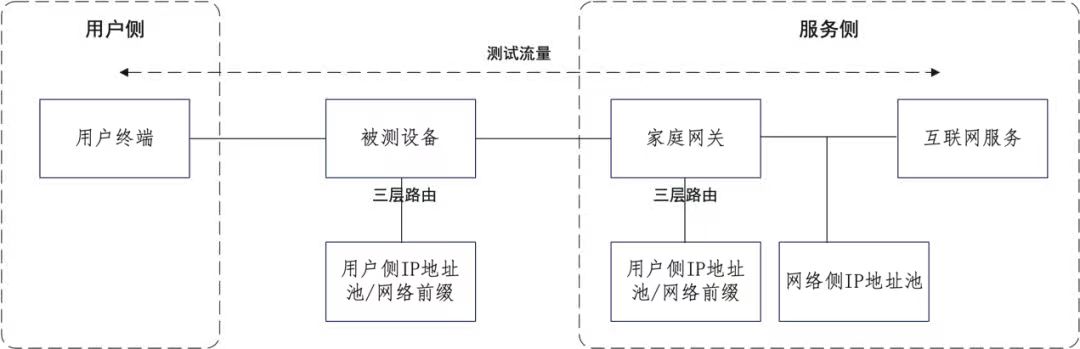
Home test topology 1: Three-layer routing mode of the residence/business gateway, and Layer 2 bridging mode of the wireless local area network equipment
The home/business gateway (optical modem) serves as the edge device of the user's network, connecting to the operator's network upwards. The home/business gateway operates in a three-layer routing mode, capable of providing dial-up access to the network and allocating IP addresses to downstream users. The wireless local area network device (the tested device) connects upwards to the home/business gateway device and downwards to the user terminal device, and operates in a two-layer bridging mode, transparently transmitting IPv6 data packets.
2. Test Steps
(1) Step 1: The home/business gateway is set up according to test topology 1. The home/business gateway is configured to operate in three-layer routing mode. On the WAN interface of the home/business gateway, user accounts and passwords are configured, and dial-up access to the operator's network is performed. On the LAN interface of the home/business gateway, the IP address allocation method for users is configured. In the IPv6 environment, any one of the SLAAC method, SLAAC DNS extension, and DHCPv6 methods can be selected.
(2) Step 2: Check the relevant information of the home/business gateway. The device successfully dials up, the WAN interface of the home/business gateway can be assigned an IPv6 address, and an IPv6 network prefix is provided for assigning IPv6 addresses to the LAN-side users of the home/business gateway.
(3) Step 3: The wireless local area network device (the device under test) is connected to the home/business gateway according to test topology 1 and configured to operate in the Layer 2 bridging mode.
(4) Step 4: Connect the LAN interface of the wireless local area network device using the user terminal, or access through the wireless local area network. Enable the IPv6 protocol stack on the user terminal. If the method of allocating IPv6 addresses to users is SLAAC on the home/business gateway, configure DNS on the user terminal as "2400:3200::1" or any other available IPv6 DNS; if the configuration on the home/business gateway is for other methods of allocating IPv6 addresses to users, no DNS information needs to be configured on the user terminal.
(5) Step 5: Check whether the user terminal has obtained IPv4 and IPv6 addresses.
(6) Step 6: Access websites that support IPv4 and those that support IPv6 through the user terminal, and observe the access status.
3. Expected Results
In step five, the user terminal is able to obtain IPv4 and IPv6 addresses, and the network prefix of these addresses is consistent with the configuration information of the home/enterprise gateway.
(2) In step six, the user terminal successfully accessed websites that support both IPv4 and IPv6.
4. Criteria for Judgment
The results are in line with expectations. The wireless local area network equipment passed the IPv6 functionality test in test scenario one; otherwise, it failed.
(2) Test Scenario Two
Test environment
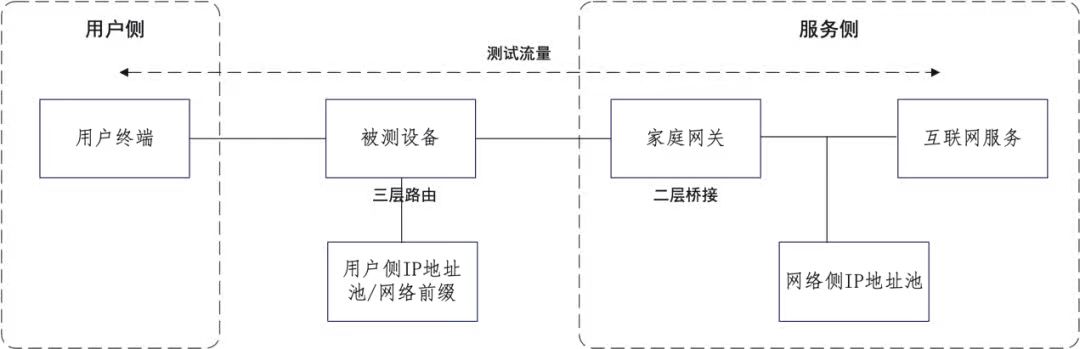
Test Topology 2: Layer 2 Bridging Mode for Home/Enterprise Gateway, Layer 3 Routing Mode for Wireless Local Area Network Devices
The home/business gateway (optical modem) serves as the edge device of the user's network, connecting to the operator's network upwards. The home/business gateway operates in the Layer 2 bridging mode. The wireless local area network device (the tested device) is connected to the home/business gateway device and works in the Layer 3 routing mode. It supports dial-up access to the network, has the default IPv6 protocol stack, and has the ability to allocate IP addresses to downstream users.
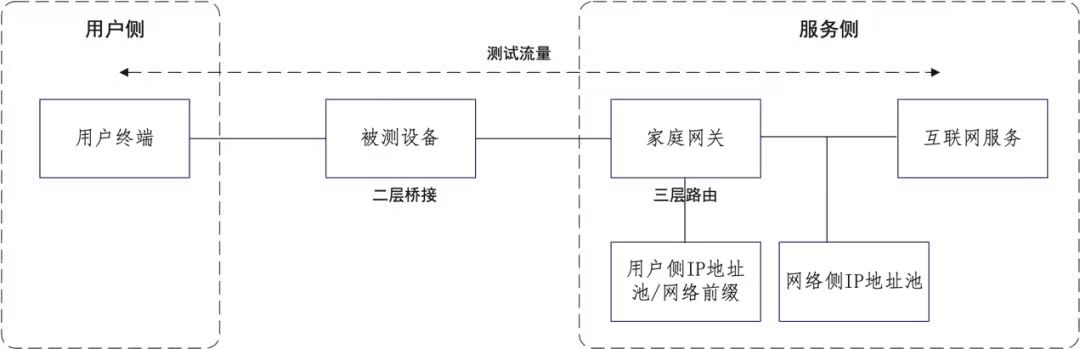
Test topology 3: Optical modem routing mode, wireless local area network device three-layer routing mode
The home/business gateway (optical modem) serves as the edge device of the user's network, connecting to the operator's network on the upper side and to the wireless local area network devices on the lower side. The home/business gateway operates in the three-layer routing mode. The wireless local area network device (the tested device) connects to the home/business gateway device on the upper side and to the user terminal device on the lower side, also operating in the three-layer routing mode. The wireless local area network device defaults to using the IPv6 protocol and assigns IP addresses to downstream user devices.
2. Test Steps
(1) Step 1: The home/business gateway is set up according to the test topology in a three-layer routing mode. The home/business gateway is configured to work in this mode, and on the WAN interface of the home/business gateway, user accounts, passwords, and dial-up access to the operator's network are configured. On the LAN interface of the home/business gateway, the IP address allocation method for users is configured. In the IPv6 environment, any one of the SLAAC method, SLAAC DNS extension, and DHCPv6 methods can be selected.
(2) Step 2: After the wireless local area network device (the device under test) is powered on and started, use the management tool/management address of the wireless local area network device to check the default configuration of the wireless local area network device and determine whether the IPv6 protocol is enabled by default.
(3) Step 3: The wireless local area network devices are connected to the home/business gateway according to the test topology 3 and configured to operate in the three-layer routing mode. On the WAN interface of the wireless local area network devices, IPv6 forwarding is configured, such as NPTv6 or IPv4/6 dual-channel, etc.; on the LAN interface of the wireless local area network devices, the user-oriented IP address allocation method is configured. In the IPv6 environment, any one of the SLAAC method, SLAAC DNS extension and DHCPv6 methods can be selected.
(4) Step 4: Connect the LAN interface of the wireless local area network device using the user terminal, or access through the wireless local area network. Enable the IPv6 protocol stack on the user terminal. If the method of allocating IPv6 addresses to users on the wireless local area network device is SLAAC, configure DNS on the user terminal as "2400:3200::1" or any other available IPv6 DNS; if the configuration on the wireless local area network device is for other methods of allocating IPv6 addresses to users, no DNS information needs to be configured on the user terminal.
(5) Step 5: Check whether the user terminal has obtained IPv4 and IPv6 addresses.
(6) Step 6: Access websites that support IPv4 and those that support IPv6 through the user terminal, and observe the access status.
3. Expected Results
(2) In Step 2, after the wireless local area network device is powered on and initialized, the IPv6 protocol stack should be enabled by default and no additional configuration is required.
(2) In step five, the user terminal can obtain IPv4 addresses, IPv6 addresses, the network prefixes of both IPv4 and IPv6 addresses, and the configuration information of the wireless local area network device is consistent.
(3) In Step 6, the user terminal was able to access websites that support IPv4 successfully; websites that support IPv6 also succeeded.
4. Criteria for Judgment
The results are in line with expectations. The wireless local area network equipment passed the IPv6 functionality test in test scenario three; otherwise, it failed.
III. Definition of Terms
PPPoE (Point-to-Point Protocol over Ethernet)
Point-to-point protocol for Ethernet links. A network tunneling protocol that encapsulates the point-to-point protocol (PPP) within the Ethernet framework, including the LCP authentication process, IPCP address allocation process, and PPP encapsulation transmission process, etc.
NDP (Neighbor Discovery Protocol)
Neighbor Discovery Protocol. In the IPv6 protocol, this protocol is responsible for discovering other nodes and their corresponding addresses on the link, determining available routes, and maintaining information about the availability of paths and other active nodes.
SLAAC (Stateless Address AutoConfiguration)
Stateless address automatic configuration. The address configuration process is completed through router requests and router announcements. It can also complete DNS information configuration by carrying the RDNSS option method.
DHCPv6 (Dynamic Host Configuration Protocol for IPv6)
The IPv6 version of the Dynamic Host Configuration Protocol. This protocol is responsible for allocating IP addresses, IP prefixes, and/or other configured network protocols to IPv6 hosts operating on IPv6 networks.
DNS (Domain Name System)
Domain Name System. Here, DNS specifically refers to the recursive domain name resolution server, which provides domain name resolution services to users. It includes mapping relationships between common resource records such as A, AAAA, CNAME and IP addresses.
ACL (Access Control List)
Access control list. A packet filtering-based access control technology that can filter data packets on an interface based on set conditions, allowing them to pass through or discarding them.
BNAS (Broadband Network Access Server)
Broadband network access server. A new type of access gateway for broadband network applications, it is located at the edge layer of the metropolitan area network. It can complete the IP network data access of user bandwidth and realize broadband Internet access for users.
FTTH (Fiber To The Home)
Fiber to the Home. This is a method of optical fiber communication, which involves installing optical network units (ONU) at the residences or businesses of users.
FTTB (Fiber To The Building)
Fiber to the building. This is a network connection mode of FTTX LAN, where the optical signal is connected into the main distribution box inside the office building to achieve the connection of optical signals. Within the office building, the signals are still distributed and input using coaxial cables, twisted pairs, or optical fibers.
Home/Enterprise Gateway
Also known as "optical modem", it is the equipment provided by operators for users to use. The current network equipment is mainly divided into two types: The first type has ONU (Optical Network Unit) and AP (Wireless Access Point). Among them, those with a three-layer routing working mode can be called intelligent gateways; those with the ONU function and in the two-layer bridging working mode can be called non-intelligent gateways.
Wireless Local Area Network equipment
Wireless access devices with IP address allocation function can be used for internal network setup in homes or enterprises.
工业和信息化部关于在型号核准中开展对无线局域网设备支持IPv6协议能力测试有关事宜的通知
(征求意见稿)
相关省、自治区、直辖市工业和信息化主管部门,青海、宁夏无线电管理机构,国务院有关部门无线电管理机构,中国电信集团有限公司、中国移动通信集团有限公司、中国联合网络通信集团有限公司、中国广播电视网络集团有限公司,相关单位:
为深入贯彻落实党的二十大精神,加快网络强国建设,扎实推动IPv6规模部署和应用向纵深发展,根据《中华人民共和国无线电管理条例》《关于加强和规范2400MHz、5100MHz和5800MHz频段无线电管理有关事宜的通知》(工信部无〔2021〕129号),现就在无线电发射设备型号核准(以下简称型号核准)中开展对无线局域网设备支持IPv6协议(以下简称IPv6无线局域网设备)能力测试有关要求通知如下:
一、生产或进口在我国境内销售、使用的具有IPv6地址分配功能的无线局域网设备,应按照有关规定向国家无线电管理机构申请并取得型号核准证,其设备应符合《关于加强和规范2400MHz、5100MHz和5800MHz频段无线电管理有关事宜的通知》等无线电管理有关规定要求。
二、IPv6无线局域网设备应支持并默认开启IPv6地址分配功能,并在产品说明书中明确IPv6配置说明。IPv6地址分配功能是否开启,由用户自行选择确定。
三、承担无线局域网设备型号核准测试任务的检测机构应具备IPv6协议相应的测试能力,并按本通知所列技术要求和测试方法开展型号核准测试。
四、基础电信运营商应支持并鼓励用户通过IPv6无线局域网设备接入互联网,同时既有IPv4无线局域网设备仍可正常接入互联网。
五、省、自治区、直辖市无线电管理机构应加强对生产、销售IPv6无线局域网设备的监督检查,对于不符合无线电管理相关规定的IPv6无线局域网设备,应及时予以查处。
六、2023年10月15日起,申请型号核准须按照本通知所列技术要求和测试方法执行。
七、本通知所称无线局域网设备是指工作在开放互联系统参考模型(OSI)网络层,并具备公网IP地址分配功能的无线局域网设备。
特此通知。
附:无线局域网设备支持IPv6协议能力技术要求和测试方法
工业和信息化部
2023年X月X日
Related News







 Follow Us
 +86-755-82984733
 sales@ecmg-global.net